
Raw Honey vs Regular Honey: What's the Difference?
Raw honey vs regular honey – what is actually the difference, and does it matter which one you buy?
Walk into almost any supermarket and you will find plenty of jars labelled simply as "honey". But look a little closer and you may also come across terms such as raw honey, unpasteurised honey, natural honey, filtered honey and local honey.
So, what do these terms actually mean?
The biggest difference between raw honey and more heavily processed honey comes down to how the honey is handled after it is harvested from the hive. Raw honey is minimally processed, while commercial honey may undergo additional heating, filtration and processing to create a very clear, consistent-looking product.
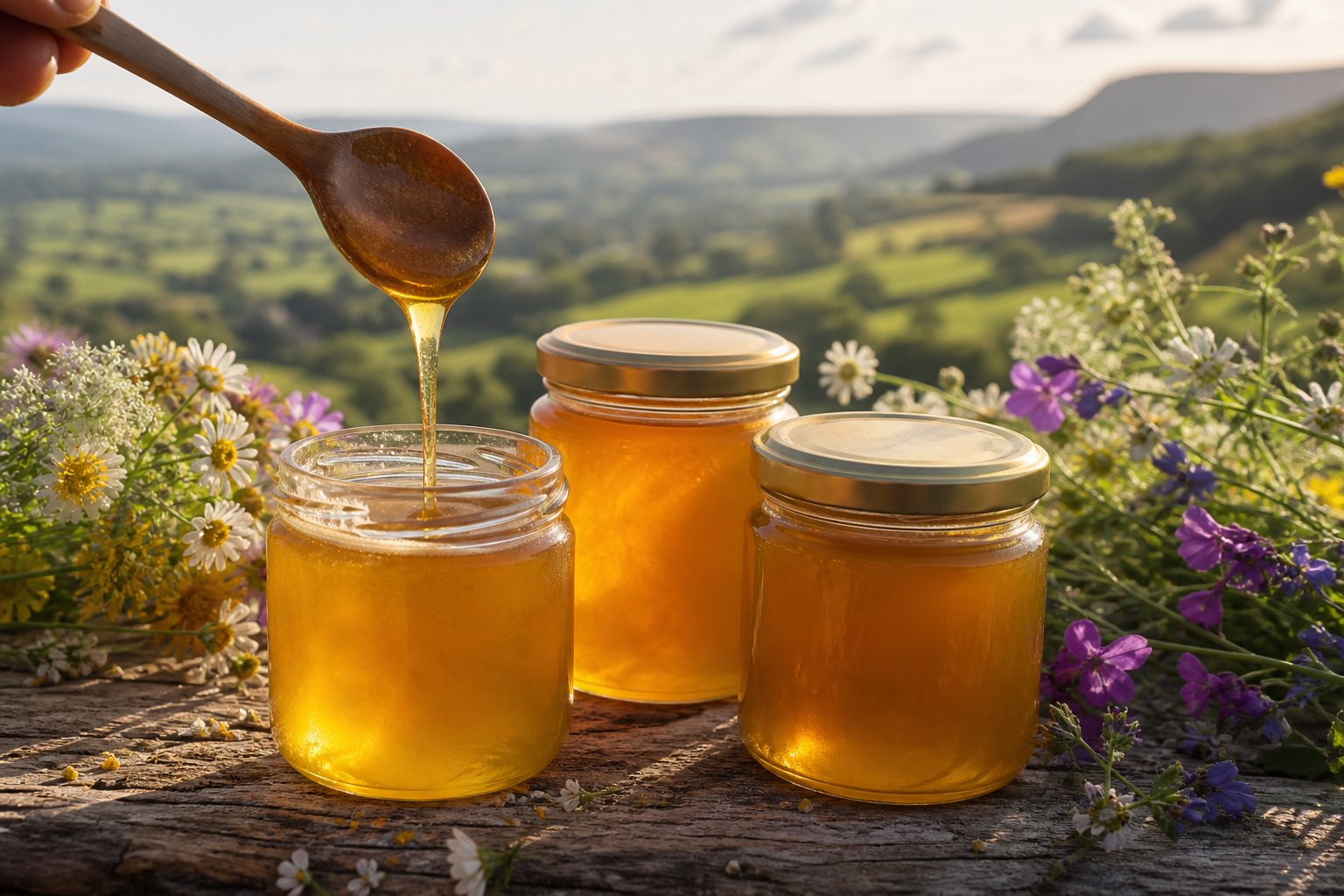
At Llangattock Apiaries, our Welsh honey is harvested from our own hives and is kept raw and unpasteurised, with nothing added and nothing taken away. Our aim is simple: to provide genuine Welsh honey that remains as close as possible to the honey produced naturally by the bees.
But what exactly makes raw honey different from regular honey? Let's take a closer look.
What Is Raw Honey?
Raw honey is honey that has undergone minimal processing after it has been harvested from the hive.
Rather than being extensively heated or highly filtered, raw honey is generally gently strained to remove larger pieces of natural debris while retaining more of the honey's naturally occurring characteristics.
At Llangattock Apiaries, our raw Welsh honey is unpasteurised and harvested directly from our own hives, with nothing added and nothing taken away.
Because raw honey is minimally processed, it can vary naturally in:
Colour
Flavour
Aroma
Texture
Thickness
Crystallisation
These differences are not necessarily signs that something is wrong with the honey. In fact, they are part of what makes natural honey so interesting.
The flowers available to the bees, the season, weather conditions and the location of the hives can all influence the characteristics of the finished honey. Llangattock Apiaries explains that even honey produced during the same season can taste slightly different because of changes in the flowers available to the bees.
What Is "Regular" Honey?
The term "regular honey" is generally used by consumers to describe commercially processed honey rather than a specific legal category of honey.
Depending on the product and producer, commercial honey may be heated and filtered more extensively than raw honey.
Heating and filtration can help create honey that is:
Clearer in appearance
More uniform in texture
Less likely to crystallise quickly
Easier to process and package at a large commercial scale
It is important to remember that not all commercially produced honey is the same. The term "regular honey" does not automatically mean poor-quality honey, and raw honey is not a completely separate substance from ordinary honey.
The fundamental difference is generally the level of processing and how much of the honey's natural characteristics are retained.
UK honey regulations set requirements around honey's composition, quality and processing. The Food Standards Agency states that honey must not be heated in a way that destroys or significantly inactivates its natural enzymes, and UK regulations also cover how honey is extracted, presented and labelled.
Raw Honey vs Regular Honey: The Main Differences
Feature | Raw Honey | More Heavily Processed Honey |
Processing | Minimally processed | May undergo additional processing |
Heating | Generally not pasteurised | May be heated during processing |
Filtration | Usually gently strained | May be more extensively filtered |
Appearance | Can vary naturally | Usually very clear and consistent |
Flavour | Can have more distinctive floral characteristics | Often more uniform |
Texture | Can be runny, thick or crystallised | Often remains more consistent |
Crystallisation | Can crystallise naturally | Processing can affect how quickly it crystallises |
Origin | Often sold directly by beekeepers | Frequently produced and blended commercially |
Natural variation | High | Usually lower |
The important point is that honey is a natural product, so two jars of genuine honey do not necessarily have to look or taste exactly the same.
Is Raw Honey Healthier Than Regular Honey?
This is one of the most frequently asked questions about raw honey.
It is tempting to describe raw honey as a "superfood" or claim that it provides dramatically more health benefits than processed honey. However, the reality is more nuanced.
Honey is still primarily a source of sugars, regardless of whether it is raw or processed. Choosing raw honey should therefore be about more than simply looking for a health claim.
One of the main reasons people choose raw honey is because it has undergone less processing and can retain more of the naturally occurring components associated with honey.
The Food Standards Agency recognises natural quality characteristics of honey, including enzymes and other compositional measures used to assess honey quality and the effects of heating and storage.
For many people, the appeal of raw honey is therefore about natural production, flavour, provenance and minimal processing, rather than expecting it to be a medicine or cure.
Does Raw Honey Taste Different?
It can.
One of the most enjoyable things about genuine raw honey is that the flavour can vary depending on the flowers the bees have visited.
Honey produced from different floral sources can have completely different flavour profiles.
Some honey can be:
Light and delicate
Floral and fragrant
Rich and earthy
Sweet and creamy
Strong and aromatic
Slightly fruity
At Llangattock Apiaries, the range includes different varieties of honey, including Heather Honey, Soft Set Honey, Runny Honey and a selection of naturally flavoured and infused honeys.
This gives customers the opportunity to explore different tastes rather than expecting every jar of honey to taste identical.
Why Does Raw Honey Crystallise?
If you buy raw honey and notice that it becomes thicker or develops crystals over time, don't throw it away.
Crystallisation is a natural process that occurs because honey contains different types of naturally occurring sugars, including glucose and fructose.
Some varieties of honey crystallise relatively quickly, while others can remain runny for much longer.
The floral source of the honey can influence how quickly crystallisation occurs.
Is crystallised honey safe to eat?
Yes. Crystallisation does not mean your honey has gone bad.
It is a natural change in texture and does not mean that the honey needs to be thrown away.
This is particularly useful to remember when buying raw honey. Its texture may change naturally over time, whereas highly processed honey may have been treated specifically to maintain a more consistent appearance.
If your honey has crystallised and you prefer it runny, Llangattock Apiaries recommends gently warming the jar in warm water and stirring until the honey returns to a liquid consistency. High temperatures should be avoided.
Why Does Raw Honey Sometimes Look Cloudy?
Another common question is:
"Why isn't my raw honey completely clear?"
The answer is simple: natural honey doesn't necessarily have to look perfectly clear.
Raw honey can contain naturally occurring fine particles and microscopic components that may have been removed through more intensive filtration.
The colour and clarity of honey can also vary depending on its floral source.
This means that clear honey isn't automatically better honey, just as cloudy honey isn't automatically evidence of higher quality.
What matters is how the honey has been produced, handled and labelled.
Is Local Honey the Same as Raw Honey?
No – these terms describe different things.
Raw honey refers primarily to how honey is processed.
Local honey refers primarily to where the honey comes from.
A honey can therefore be local without being raw, and raw without necessarily being local.
This is an important distinction when you're shopping for honey.
At Llangattock Apiaries, customers can enjoy the combination of raw, unpasteurised Welsh honey produced from the company's own hives in South Wales.
Buying directly from a beekeeper also gives consumers a much clearer connection between the producer, the bees and the finished jar of honey.
Is Raw Honey Better Than Supermarket Honey?
There isn't a single answer that applies to every supermarket honey.
However, if your priority is minimally processed, locally produced honey with a clear connection to the beekeeper, raw honey from a local apiary can be an attractive choice.
When choosing honey, consider:
1. Where does the honey come from?
Look for clear information about the country or region of origin.
UK honey labelling regulations include requirements relating to the origin of honey and honey blends.
2. Has it been heavily processed?
If you specifically want raw or unpasteurised honey, check the product description and packaging.
3. Does it contain anything else?
Pure honey should not need added sugar or artificial sweeteners.
Llangattock Apiaries states that its honey contains no added sugars or artificial ingredients.
4. Can you identify the producer?
Buying directly from a beekeeper can provide greater transparency around where the honey comes from and how it is produced.
5. Does the honey look different from another jar?
That's not necessarily a problem.
Natural honey can vary in colour, consistency and flavour depending on the season and floral sources.
Why Choose Raw Welsh Honey From Llangattock Apiaries?
At Llangattock Apiaries, we believe honey should be enjoyed for what it naturally is.
Our honey is:
🍯 Raw and unpasteurised
Our Welsh honey is harvested directly from our own hives and kept as close as possible to its natural state.
🐝 Produced by our own bees
Rather than simply selling generic honey, Llangattock Apiaries produces honey from its own hives in South Wales.
🌿 Naturally varied
The changing Welsh landscape, weather and flowers available to the bees all contribute to the character of the honey.
🚫 No added sugars
Our honey is produced without added sugar or artificial ingredients.
♻️ Ethically and sustainably produced
Llangattock Apiaries places a strong emphasis on environmentally conscious beekeeping and bee welfare.
🚚 Delivered across the UK
You don't need to live next door to the apiary to enjoy genuine Welsh honey. Llangattock Apiaries delivers its products across the UK.
Raw Honey vs Regular Honey: Which Should You Choose?
If you're looking for honey that is minimally processed, unpasteurised and produced directly by a Welsh beekeeper, raw honey is an excellent option to consider.
The biggest difference between raw and more heavily processed honey is not that they come from different sources – both begin as honey produced naturally by bees.
The difference is what happens after the honey leaves the hive.
More heavily processed honey can be heated and filtered to create a clearer, more consistent product, while raw honey is handled more gently to retain its natural characteristics.
For people who value natural food, local provenance, traditional beekeeping and distinctive flavour, raw Welsh honey offers something special.
At Llangattock Apiaries, we keep things simple: pure Welsh honey, just as the bees make it.
Frequently Asked Questions About Raw Honey
What is raw honey?
Raw honey is honey that has undergone minimal processing after being harvested from the hive. It is generally gently strained rather than heavily filtered or processed. Llangattock Apiaries produces raw, unpasteurised Welsh honey directly from its own hives.
What is the difference between raw honey and regular honey?
The main difference is processing. Raw honey is minimally processed, while commercially processed honey may undergo additional heating and filtration to create a clearer and more consistent product.
Is raw honey better than regular honey?
Many people choose raw honey because it is minimally processed and retains more of its natural characteristics. However, honey is still a source of sugar, so it should be enjoyed as part of a balanced diet rather than viewed as a medicine.
Why does raw honey crystallise?
Crystallisation is a natural process caused by the sugars naturally present in honey. Different floral varieties can crystallise at different rates. Crystallised honey is not necessarily spoiled.
Can you eat crystallised raw honey?
Yes. Crystallised honey can be eaten just like runny honey. If you prefer a liquid consistency, gently warm the jar in a bowl of warm water.
Is raw honey unpasteurised?
Raw honey is commonly associated with minimally processed and unpasteurised honey. Always check the producer's description. Llangattock Apiaries states that its Welsh honey is raw and unpasteurised.
Does raw honey contain added sugar?
Pure honey should not require added sugar. Llangattock Apiaries states that its honey contains no added sugars or artificial ingredients.
Does raw honey expire?
Honey has a very long shelf life when stored correctly. Keep the jar sealed and store it in a cool, dry place away from direct sunlight.
Can babies eat raw honey?
No. Honey should never be given to babies under 12 months old because of the risk of infant botulism. This applies to raw, unpasteurised and processed honey.
Where can I buy raw Welsh honey?
Llangattock Apiaries produces raw, unpasteurised Welsh honey from its own hives in South Wales and offers delivery across the UK. You can explore the range of honey and natural bee products online.
Discover Genuine Raw Welsh Honey
If you want to experience the difference that minimally processed honey can make, explore the range from Llangattock Apiaries.
From runny honey and soft set honey to distinctive floral varieties and honeycomb, there is a natural Welsh honey to suit different tastes.
Pure Welsh honey. Raw. Unpasteurised. From our own hives.
Explore the Llangattock Apiaries range and discover genuine raw Welsh honey delivered across the UK.
Comments